


For a long time, corporate gifting was simple.
A company wanted to appreciate an employee, reward a dealer, thank a customer or celebrate a milestone.
So it bought a gift.
The questions were usually:
What should we buy?
How much should we spend?
How do we deliver it?
Today, businesses are beginning to ask different questions:
Will the recipient actually value it?
Can they choose something relevant to them?
Can the reward reach them at the right moment?
And did the reward achieve its purpose?
That change in thinking is important.
Because the future of gifting may not really be about gifts.
It may be about engagement, behavior and business outcomes.
The Problem With Traditional Gifting
Traditional gifting usually starts from the company’s point of view.
The organization chooses the item.
The recipient receives it.
The problem is simple:
The company chooses. The recipient adjusts.
But people value different things.
An employee may prefer shopping.
A customer may care more about travel or dining.
A salesperson may respond to one kind of incentive, while a dealer may value something completely different.
Two rewards can cost exactly the same amount and still create very different experiences.
So the real value of a reward is not determined only by what the company spends.
It is determined by what the recipient experiences.
Choice Is Becoming Part of the Reward
Consumers today are used to choice.
We choose what to watch.
We choose what to order.
We choose where to shop.
We choose how to pay.
It is natural that people increasingly expect similar flexibility in rewards.
Deloitte’s 2024 global Consumer Loyalty Survey, which included more than 9,800 consumers across markets including India, found that four out of five consumers value flexibility in earning and redeeming rewards. The same study found that financial rewards, simplicity and ease of use remain among the most important program attributes.
That research is about loyalty programs, not corporate gifting specifically.
But the implication is relevant:
People increasingly value flexibility, simplicity and control.
A good reward should therefore offer more than monetary value.
It should offer relevance.
A Large Catalogue Is Not a Reward Strategy
Offering more brands and more reward categories can improve choice.
But a catalogue alone does not create engagement.
A catalogue answers:
“What can we give?”
A reward strategy should answer:
“Why are we giving it?”
Before issuing a reward, an organization should understand:
- Who are we rewarding?
- Why are we rewarding them?
- What behavior are we trying to encourage?
- What will feel meaningful to that person?
- What outcome are we trying to create?
Without those answers, businesses can become very efficient at distributing rewards without necessarily becoming better at creating engagement.
Enrollment Is Not Engagement
The loyalty industry provides a useful lesson.
Deloitte’s 2025 Consumer Loyalty Program Survey found that the average consumer was enrolled in eight loyalty programs but actively participated in only five. It also found that 72% of respondents said loyalty programs made them more likely to spend with their preferred brand, while 56% said the program increased their spending.
The survey covered 5,564 US adults who were loyalty-program members, so these findings should be read in that context.
The lesson is simple:
Enrollment is not the same as engagement.
A person may join a program.
They may receive a reward.
They may even redeem it.
But that does not automatically mean they become more engaged or loyal.
A simple way to think about it is:
Enrollment → “I joined.”
Redemption → “I used the benefit.”
Engagement → “I keep coming back.”
Loyalty → “I continue choosing you.”
That distinction matters when businesses design reward programs.
A Simple 5R Framework for Modern Rewards
A useful way to think about modern reward programs is through five questions.
Right Person
Who are we rewarding?
An employee, customer, salesperson, dealer and channel partner may all respond differently.
Right Reason
Why are we rewarding them?
Recognition?
Retention?
Performance?
Repeat purchase?
Channel activation?
The purpose should be clear before the reward is selected.
Right Reward
What will actually feel valuable to that person?
A more expensive reward is not automatically a better reward.
Relevance and choice matter.
Right Moment
When should the reward happen?
Recognition can lose impact when it arrives too late.
Timing can materially change how the reward is experienced.
Right Outcome
What happened after the reward?
Did participation increase?
Did the customer return?
Did the salesperson perform better?
Did the dealer engage more?
Did the employee feel recognized?
This is where reward programs begin moving from distribution toward measurement.
Same Spend. Different Experience.
Consider two companies.
Both want to recognize an employee for achieving an important milestone.
Both spend ₹1,000.
Company A selects a standard item and delivers it several weeks later.
Company B recognizes the achievement immediately and gives the employee flexibility to choose a reward they actually value.
The monetary cost may be similar.
The experience is not.
The difference comes from:
Relevance.
Timing.
Choice.
Ease.
These factors can matter as much as the monetary value itself.
Technology Becomes Important at Scale
When a company rewards ten people, the process can often be managed manually.
When an enterprise is engaging thousands of employees, customers, salespeople, dealers or partners, the problem changes.
The organization begins needing:
- program rules
- eligibility
- budgets
- approvals
- reward issuance
- redemption management
- reconciliation
- reporting
- audit visibility
- integrations
- analytics
At this stage, gifting is no longer only a procurement activity.
It becomes a technology and operations problem.
Deloitte’s 2025 research also points to easy redemption, meaningful personalization and intuitive digital experiences as important elements of stronger perceived value and engagement.
Where GiftM Fits Into This Change
At GiftM, we do not see the opportunity as simply putting more gift cards into a catalogue.
Digital gift cards are important.
But they are one layer of a much larger system.
The broader opportunity is to help organizations design and manage reward, loyalty and incentive experiences across:
Employees
Recognition, milestones and engagement.
Customers
Loyalty, retention and repeat engagement.
Sales Teams
Targets, achievement and performance incentives.
Dealers & Distributors
Schemes, channel engagement and performance programs.
Business Partners
Recognition, incentives and relationship programs.
The role of technology is to connect these programs with digital rewards, redemption, controls and integrations in a way that is easier to manage and scale.
The objective is not to make gifting more complicated.
It is to make it more relevant, more timely and more measurable.
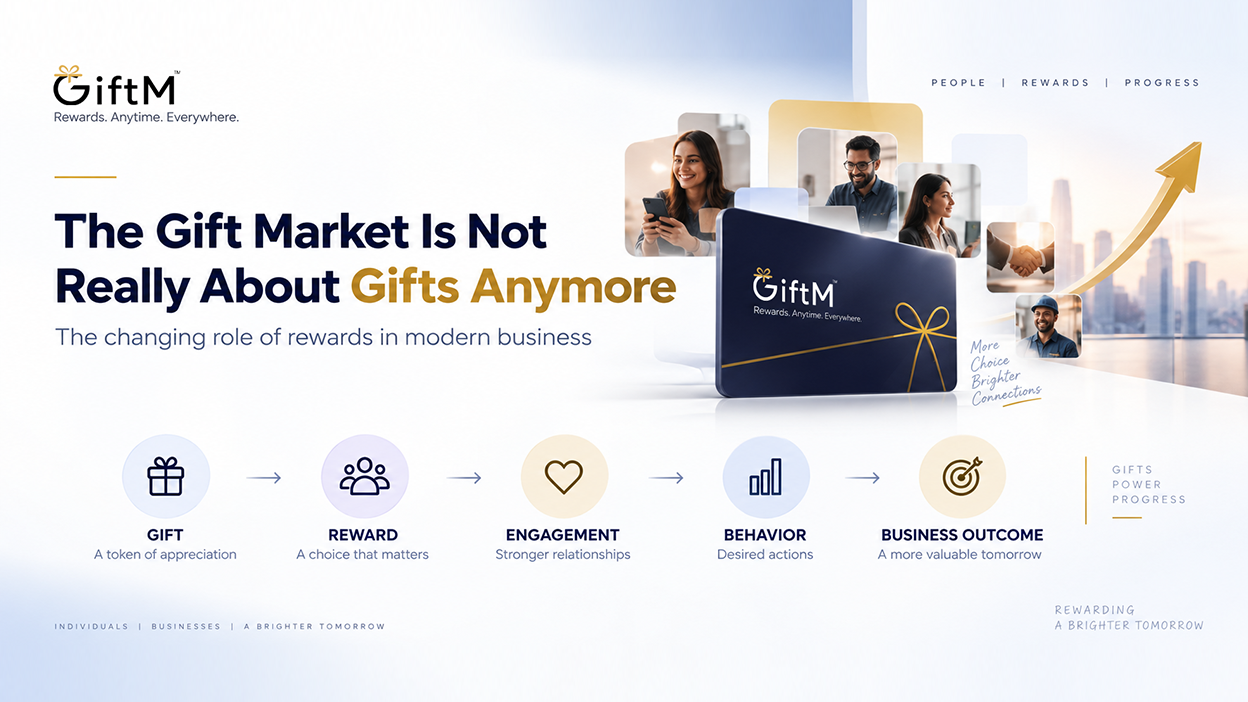
From Gifts to Business Outcomes
The evolution of the category can be understood simply:
Gift → Reward
Reward → Engagement
Engagement → Behavior
Behavior → Business Outcome
The gift does not disappear.
It becomes part of a larger engagement system.
That changes the question businesses should ask.
Not only:
“What should we give?”
But:
Who should we reward?
Why should we reward them?
What will they value?
When should the reward happen?
And what happened next?
That is where the next phase of the rewards market becomes interesting.
Because ultimately, the objective is not to distribute more rewards.
It is to make every reward more relevant — and every program more purposeful.
That is the opportunity we are working toward at GiftM.